

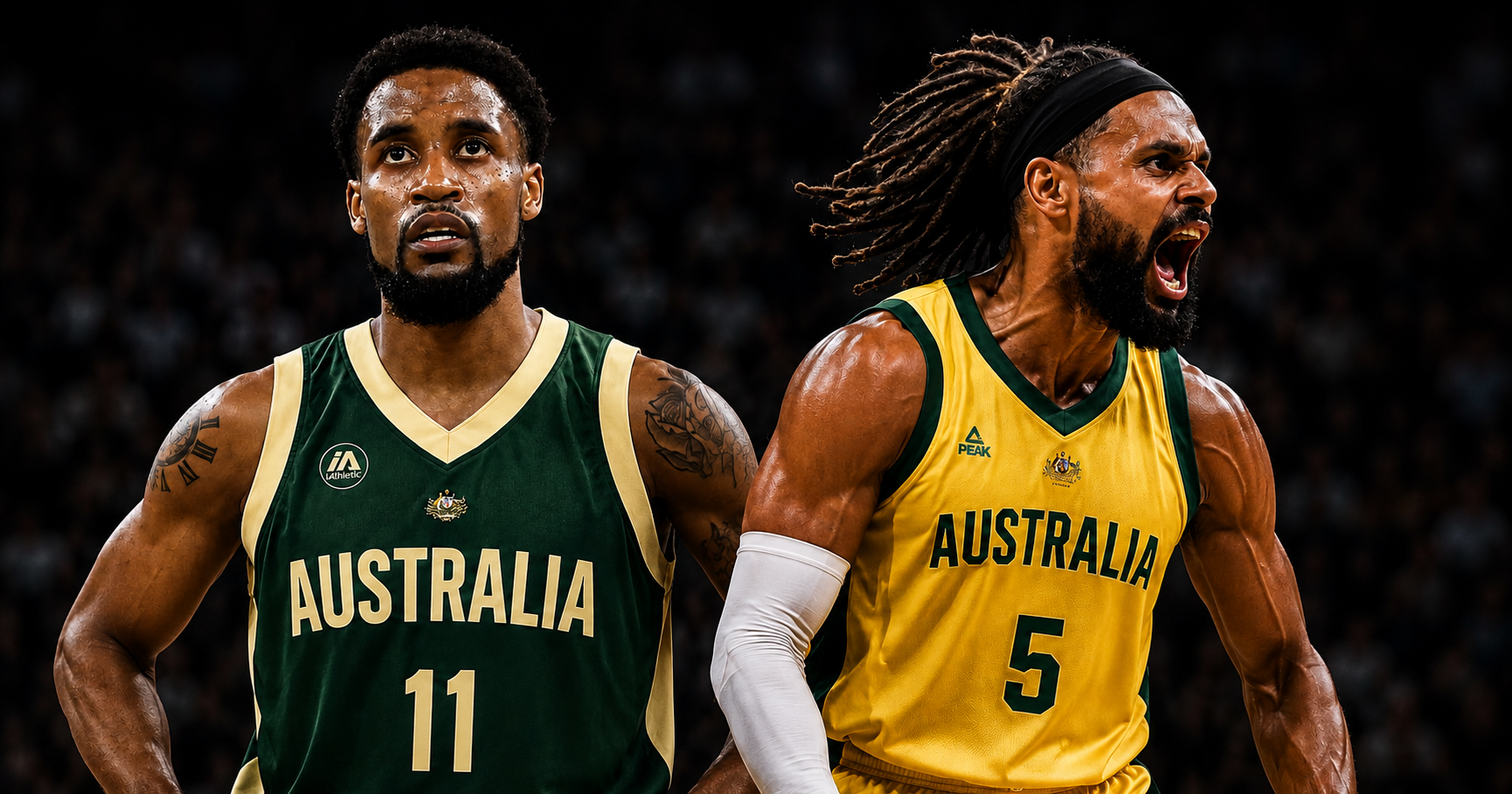
At some point over the next 12 months, the Boomers are going to have to make a decision that Australian basketball has managed to avoid for almost two decades.
Who exactly is this team built around now?
Since 2010, that answer was simple. It was Patty Mills’ team.
Mills has been the primary scorer for the Boomers for nearly two decades and few Australian victories have been recorded without a major scoring performance from Patty.
But as the Boomers move toward the 2027 FIBA World Cup and eventually the 2028 Los Angeles Olympics, the reality is becoming clearer with every major tournament: this is now Josh Giddey’s team.
And once you accept that, the rest of the roster construction conversation starts to change very quickly.
Giddey averaged over 30 minutes per game at the Paris Olympics and was already operating as Australia’s primary initiator and offensive organiser throughout stretches of the tournament. Dyson Daniels averaged 27 minutes per game and established himself as arguably Australia’s most important perimeter defender.
Both players are still years away from what should be their prime. If anything, their roles are only going to increase.
That creates a difficult question Basketball Australia and Adam Caporn are eventually going to have to answer internally: where exactly do Patty Mills and Bryce Cotton fit in a backcourt now built around Giddey and Daniels?
The issue isn’t talent. It’s fit.
Australian basketball legend Andrew Bogut said it publicly during the Olympics build-up.
“I think if you’re starting Giddey, I don’t think you start Patty,” Bogut said on NBL Media’s The Gold Standard.“
“I think Giddey’s journey, his career’s going up, but he’s not there yet defensively. He probably needs some work on that end, and he knows that. Patty’s not a great defender. So I don’t think you can start both of those two. I think we saw that at the World Cup, I just don’t think you can start those two and play them mass minutes together.”
Even Shane Heal echoed similar concerns during Paris, noting “They have to find a way offensively to play together.” in the media.
And that’s ultimately the core of the issue.
The Boomers appear to be transitioning toward a bigger, more defensive, and more versatile identity around Josh Giddey and Dyson Daniels.
Daniels can guard multiple positions, pressure the ball full court, and increasingly initiate offence himself. Danté Exum, when healthy, gives Australia another big guard capable of defending, handling the ball, and playing alongside Giddey.
Some of the Boomers’ best stretches during recent tournaments came through Exum’s defensive pressure and ability to disrupt opposing guards, and it’s not unrealistic to think his role could increase significantly this campaign if healthy.
The more Australia leans into Giddey, the harder it becomes to justify smaller score-first guards playing heavy minutes alongside him. Historically, Mills was most effective playing alongside true point guards with defensive skillsets.
Previously, Matthew Dellavedova handled primary creation duties while Mills operated off movement, off screens, and as a scoring shooting guard. Even when Dellavedova wasn’t on court, playmaking was handled more by Andrew Bogut or Joe Ingles in previous events than Mills.
Now, Giddey firmly occupies that role, Daniels increasingly takes secondary creation possessions and a healthy Dante Exum (23 minutes per game last campaign) almost locks up all of the minutes available in the backcourt.
If both Giddey and Daniels are playing 30-plus minutes as the starting guards. Exum (or Proctor) a healthy 15 minutes, suddenly the available minutes become extremely tight.
There are realistically only around 20 combined minutes available across the remaining guard spots if the Boomers maintain large workloads for Giddey and Daniels, and even less with a healthy Exum.
That’s where the Mills and Cotton discussion becomes complicated.<p>
Both are at their best playing as scoring guards. Both need the ball at times to maximise their offensive impact. Neither is ideally suited to playing major minutes as a defensive-minded backup point guard behind Giddey.
IF Patty Mills accepts a reduced role. Maybe that means 10-to-20 minutes per game as a microwave scorer and veteran leader off the bench.
But there are already rumours internally that Mills may not be overly motivated by the idea of playing a heavily reduced role within the Boomers setup after being the face of the program for so long.
It was noticeable throughout Paris that the Boomers often functioned better when Josh Giddey and Patty Mills had staggered minutes, allowing each player to control the offence separately rather than sharing the floor for long stretches.
There is also belief internally that Giddey found it difficult at times playing alongside Mills, particularly as the offence increasingly shifted toward Josh Giddey and Jock Landale running pick-and-roll for large portions of the tournament.
Even Brian Goorjian’s rotations increasingly leaned that way throughout patches of the Olympics, with Australia often looking more balanced when one of the two guards was operating with the second unit.
With Mills now three years older, slower defensively, and no longer the same level of perimeter defender, the question becomes where exactly he fits on the floor within the Boomers’ current structure.
And even if Mills accepts that reduced role, where does Bryce Cotton fit?
Five minutes?
Ten?
It becomes increasingly difficult justifying carrying both players in a 12-man roster when their skillsets overlap so heavily.
And then comes the naturalised player complication.
Under FIBA rules, Australia can only carry one naturalised player into a major tournament. That means Bryce Cotton and Matisse Thybulle are effectively competing for the same roster spot.
Thybulle’s future with the Boomers remains unclear following his omission from the Paris Olympics squad. Since being cut, he has remained relatively quiet publicly around the program and there’s still uncertainty around whether he remains committed long term.
Purely from a basketball fit perspective, though, Thybulle arguably makes more sense than Cotton.
Australia already has ball handling through Giddey, Daniels, Exum, Tyrese Proctor, Taran Armstrong, and potentially Will McDowell-White moving forward.
What Australia doesn’t have much of is elite point-of-attack defence against the world’s best guards and wings.
That’s what Thybulle provides.
But if Thybulle is out of the picture, and Mills either declines or moves away from the program, suddenly Cotton makes a lot more sense.
Especially if the Boomers feel they need another perimeter scorer capable of generating offence late in games.<p>
The biggest unresolved issue may actually sit behind Giddey.
The Boomers still need another true initiator capable of running offence when Giddey sits. A healthy Danté Exum is probably the cleanest answer if available, given his size, defence, and ability to play on or off the ball.
But Exum’s injury history continues to create uncertainty around long-term availability. That’s where the next wave becomes important.
Proctor has show he would be the most solid replacement for Exum if he’s unavailable. Taran Armstrong is becoming one of the countries best playmakers. Will McDowell-White remains in the mix.
And as unlikely as it may seem to some, Matthew Dellavedova’s competitiveness and fit alongside larger creators means he probably can’t be completely ruled out either.
The frontcourt still feels fluid heading toward this next World Cup cycle. Jock Landale remains the clear starting centre, but behind him there are multiple directions Australia could go with Duop Reath, Rocco Zikarsky, Lachlan Olbrich, Will Magnay, Xavier Cooks, and others all fighting for a spot.
The backcourt, however, feels much more defined. This program is moving forward with Josh Giddey and Dyson Daniels as its foundation pieces and a clear role for Exum if healthy.
And once that becomes the priority, and discounting major injuries, it’s there simply isn’t room to field a team with both Patty Mills and Bryce Cotton on it at the same time.